Correspondence and family papers, 1869–2005
Letters & Family Papers
A farm-clearing agreement from 1879, a Treasury Department nephew writing home in 1905, a deathbed hymn in 1919, the only letters May and William ever wrote each other, William's sister in her last arthritic years, and thirty pages a favorite niece kept for sixty years — the family's own words, transcribed here in full rather than summarized, in the order they were written.
Conventions:
[word?]= uncertain reading,[illegible]= unreadable, original spelling and punctuation preserved.Privacy note: nine pages of Pat Cameron's letters (pages 5–10, 12–13, 18, and 20–21, in the last section below) contain intensely personal material and are held in the family's private file, outside this shared site.
The Oldest Papers, 1869–1926
Long before May kept a diary, the Harlow side of the family was already writing things down — a doctor's receipt, a land-clearing contract, a homesick nephew's letters from Washington, a deathbed hymn. Scanned in August 2026 from the "New May Info" folder and a companion batch. Three related items belong to this same bundle but are transcribed in full on the Farm page's Depression chapter instead of repeated here: the March 1933 Federal Land Bank letter, David T. Harlow's Goldsmith Bank passbook (1926–37), and May's June 1915 University of New Mexico certificate.
1869–1896 — A receipt, a land-clearing contract, a promissory note, and an inheritance
November 29, 1869 — the oldest document in the archive
Orlando Harlow paying an Indianapolis doctor to treat his teenage son David. Full text and image are on the Farm page; in short: "I will attend on David Harlow until the disease is removed... if at any time the disease should return, I obligate myself to treat David Harlow free of charge." Five years after buying the farm, a hundred dollars for one son's treatment — the same son who would inherit the land and, sixty years later, sign the 1919 church letter and 1926 obituary draft further down this page.
March 1, 1879 — D. T. Harlow & Marion Stiver, a land-clearing agreement
Seven years before he'd marry Dora Wilcox, seventeen-year-old David T. Harlow contracted a neighbor to turn his father Orlando's woods into field.
March 1/79.
Article of an agreement:
D. T. Harlow on the first part and Marion Stiver on the second part.
do agree as equal partners to clear and fence & ditch about (7) seven acres of ground (rails allowed) (about 60 rds) and to cultivate the same on the farm of the first part together with about (5) five acres which is already cleared; each doing half the work & receiving half the profit. The second part is also to receive from the first part $1.50 per acre for all ground cleared. The first part also agrees to furnish the second part a house in which to live for one year from the above named date and all the implements together with half the team with which to farm the above named ground.
The second part agrees to give quiet and peaceable possession at the expiration of one year from date if desired by first part.
Both also agree that on failure of either part, the other shall be made equal out of the crop to the amt. of failure.
The second part agrees to preserve as much as possible all with which he is entrusted.
Notable: A rare surviving record of how the farm's woods became field a generation before William (b. 1892) — half-shares clearing plus $1.50/acre, a year's house and implements furnished. The same Stiver/Stivers family reappears on the undated promissory note below.
Undated (April 16, 18[5?]0) — a promissory note, Sharpsville
Sharpsville, Tipton Co. Ind
Six weeks after date we promise to pay to the order of [T. A.?] Brooks seven Dollars for value Received of him without any Relief from valuation or apprasement laws with interest at eight percent from date until paid.
this the 16th of April 18[5?]0Marian [his x mark] [F.?] Stivers
David [S…] (remainder torn away)
Notable: $7 payable to [T. A.?] Brooks at 8% interest; signed by Marian Stivers (by his mark) and a second signer whose surname is lost to a tear in the paper. The date reads as 1850 or 1880 — either the Stiver family's dealings with the Harlows go back further than the 1879 agreement above, or this is a later note from the same neighborly credit network.
March 3, 1896 — "your share of Charley's estate"
[Waldron?] Ind March 3-96
Mrs Dora
Enclosed please to find Draft for $67.50 this being your share of Charleys estate
Please to send receipt of the same to us all as usual
Resp[ectfully]
[Chip?](in pencil, added later:)
Mar 21st 1896 please pay to David T. Harlow $67.50 — Ida E Harlow
Notable: To "Mrs Dora" — Ida Eldora "Dora" (Wilcox) Harlow — transmitting her $67.50 share of "Charley's estate," almost certainly her half-brother Charles S. Wilcox, who died at nineteen in 1893. The pencil endorsement, in Dora's own hand, signs the draft over to her husband David T. Harlow — confirming David T. as Dora's husband.
1905 — Two letters from a Treasury Department nephew
Two long letters on Treasury Department memo stationery, Takoma Park, D.C., to "Dear Aunt Dora" — Ida Eldora Wilcox Harlow — signed only "Wilmer." He worked for the Treasury, dealt real estate on the side, and had a wife named Clara and at least four children, including sons Doran and Gilbert. He is almost certainly the namesake for Dora's own son, born 1892: William Wilmer Harlow.
March 23, 1905
(Ed. 7-13-1904—250,000.) No. 1765. TREASURY DEPARTMENT
Takoma Park, D.C.
March 23, 1905.Dear Aunt Dora,
I know you will be surprised to receive an answer to your letter so promptly. Your letter was received last night and I was so glad to hear from you that I answer now with the hope that you will also have an inspiration to keep it up.I wish we could drop in on you and enjoy some of your maple syrup, but best of all some of the spare ribs when you butcher. Do you know that I have not seen an old fashioned Indiana spare rib, that is a spare-rib with meat on it, since I came to Washington. I know we would all enjoy a visit with you so much and some day we are coming. I am so glad that I got to see you last summer, and am very sorry that I did not get to see Uncle David. I know I would like him and I would just make him like me, I am not going to let up on insisting on both of you coming to Washington. While it is true the distance seems great, in fact the trip is an easy one. You would not have to change cars after leaving Indianapolis, and it only takes 17 hours to make the trip. We caint feed you on fresh milk, and the good fresh things you have on the farm but we will give you something "filling" so that you will not have to go hungry. I want you to write me more about your boys and girls, so that we will feel that we know them. We are anxiously awaiting their pictures but we want to know about them too. Did you not say one of the girls was going to teach? Did Richard stay in the store or did he conclude to go to school? Tell me all about them. I know you are proud of them, and aside from what you told me yourself. I know from what May has told me that you have just cause for pride in them. It certainly is a great comfort to parents to have the right sort of children, and we, like you, think we have every reason for thinking our boys are all right, they are both getting along nicely in school, and both are manly boys, and neither of them has ever given us cause for one moment of anxiety.
Clara has had unusually good health this winter, and I never felt better in my life. We have not had a physician in the house for over a year, and I trust we will not need one for several years to come.
Yes it would be nice if our children would get up a correspondence. I have tried to get our boys and Mays children to write but have failed. However let us try. Your children could write of many things that would interest the boys, and I have no doubt but what they in turn could tell them things about Washington that would interest them. I came near forgetting to answer Willies question about Dorans clothes. The picture was taken in his Cadet uniform or the suit he wears to school. They have here in connection with the high school a system of military training, the boys may take this or not just as they choose. There are five high schools, and from these schools they have this year a full regiment of cadets, consisting of 12 companies, and about 800 boys. They have to drill for two hours twice each week, and at the end of the school year they always have a competative drill. they have to drill in the same tactics and manuel of arms as do soldiers in the regular army, and it is splendid exercise for developing a boy physically. you can see from Dorans picture what an erect figure he has, and this is due largely to his training in the cadet corps.
Possibly your boys would be interested in a description of Dorans school. As I have said there are five high schools but they are all under one Superintendent. Three of them the "Eastern", "Western" and "Central" are purely Academic schools, the "Business" in addition to the Academic course has a course of business instruction and the "McKinley Technical" (which Doran attends) has in addition to the Academic course, a course in Mechanical drawing, and manuel training. They have mechanical drawing during the whole four years course, and are taught to draw plans and designs for anything from a house to a steam engine. for manuel training the boys have the first year, Wood turning, and learn the use of the wood lathe and to turn out anything from a plain cylinder to the most complicated urn or vase; the second year they have forgeing, they are put at a forge, and learn how to make the things that are made in an ordinary blacksmith shop; the third year they are put in the machine shop. here they learn the use of the steel lathe and to make things from models, and the work done here is really wonderful. during this year they also learn to run a stationary engine, each boy having to take his turn at the immense engine which runs all the machinery connected with the school; in the fourth year they take up electricity and surveying. the boys are taken out in the country where they make actual surveys, and they get during the year a very good idea of electrical plants, all the dynimos in the school having been made by the boys. While all this is being done for the boys, the girls are not forgotten. The first year the girls are taught cooking, how to prepare the table &c.; the second year they have cooking and dress fitting; the third year dress making and milinary, and the fourth year milinary and house keeping. The girls who graduate from this school can make as fine a dress or as fine a hat as any dressmaker or miliner in the city, and they also know how to take care of a house. Well I have drawn this out much longer than I intended but I get warmed up when I talk or write of this school for I think it is the finest in the country, but I will not burden you with any more at this time.
Tell uncle David that he must make up his mined to come to Washington, he will never regret it I know, and if he just wont come why you come and bring some of the children for company. Now write real soon and if you have not already sent the pictures hurry them up.
Lovingly
Wilmer
Notable: No change of cars needed after Indianapolis — 17 hours Indianapolis to Washington. Dora's children discussed: one of the girls planned to teach; Richard weighing store work against school. Twelve-year-old "Willie" (William Wilmer) had asked about Doran's cadet-uniform photograph — Doran attended McKinley Technical High School's cadet corps, one of five D.C. high schools with a combined regiment of 800 boys. "May" is named as a mutual acquaintance close to both writer and Dora — this is not the diarist Lena May Carmony, whom William would not meet for another decade.
August 29, 1905
No. 1765. TREASURY DEPARTMENT
(Ed. Nov. 17-04—250,000.)Takoma Park D.C.
Aug. 29, 1905,Dear Aunt Dora.
I certainly owe you two or three apologies for not writing to you long ere this, but in truth I have been so busy that I have hardly had time to breathe. I have been trying to make some money on the outside by handling real estate and it takes up every minute of my time.We certainly did appreciate the pictures, although I will admit that I have not shown it in letting their acknowledgement go so long. Richard is certainly a fine looking young man, I can say this without hurting him any, for you know boys are not susceptible to flattery, but while I could in truth say the same thing of the girls it might have a bad effect on them. I wish you would send us the rest of them. It seems too bad that Anna May has such very poor health, and it does seem that something might be done to over come her trouble.
I wish Richard had come via Washington when at the "Falls" — I would like to know him personally and a glimpse of the Capital city would be good for him. We would also be delighted to have the girls visit us, and, we fully expect that you and Uncle David will do so. Aunt Dora, you and Uncle are working too hard, and it is time you were getting under the shade to take a rest. Better do it this fall and come to Washington. I know you would like Clara, and so would the girls, she has no frills, but just the same plain Clara as when she was a girl.
I wish we could get the young folks to write and get acquainted, but I cannot get either of the boys to write to any one. You remember when I was a boy I was inclined to be a little shy, especially of girls, and both of my boys are just a little like their "dad". Doran is working this summer in a real-estate office, but will start to school again about the middle of Sept. Gilbert ran a nail in his foot about 10 days ago in the same spot that "Pa" did, and we were frightened nearly to death, but it seems to be nearly well now. One of our girls — the oldest one — has gone to Elmira N.Y. to live with an Aunt, but Nellie is still with us. I wish she could meet your girls and be with them awhile, just to see how good sensible girls do and act, for I tell you Aunt Dora, girls here are not like our western girls. All they think about here is getting out and having a good time. I like to see young people enjoy themselves, but they can do that and have some common sense too.
I intended to send Aunt Jennie the boys pictures, but do you know we have not sent any to any-one but you as yet, so there, you see I thought of you first dident I? I am going to send them to Aunt Jennie though, and I must write to her too for she is a dear good woman and she and Chip always treat me royally when I go there. I am going to have Doran make some pictures of the places around our home, before he goes back to school, and when he does I am going to send some of the prints to you so you can have some idea of the place before you come to see us. I do not know when we will ever get back to Indiana again, but I promise that when we do we are coming to see you and in the mean time we want you to take a rest and come and see us.
I am never going to wait so long again before writing to you even if I am busy, but will find time to write.
With love to all
Wilmer(below the signature, added later in a different hand, in pencil:) Creatho?
Notable: A later annotator has pencilled "Creatho?" under the signature — apparently a family guess at the writer's surname (perhaps "Creath?") — but the ink signature clearly reads "Wilmer" and identifies him only by that first name. He calls Indiana girls "our western girls," implying he was raised there himself. Confirms Dora's children Richard (recently at the "Falls" — likely Niagara) and Anna May (in poor health), plus an Aunt Jennie and "Chip." Between the two letters he is the strongest candidate for the source of William Wilmer Harlow's middle name. Anna May's "very poor health" here, at about 21, is five years before the 1910–11 Albuquerque sanatorium episode below — see the sanatorium years.
1919–1926 — Church business, a stroke, and a deathbed hymn
November 12, 1919 — Frankfort, Indiana
Frankfort Ind.
Nov. 12, 1919.Mr. D. T. Harlow
My Very Dear Brother:
Yours of the 10" was on time and am sorry to reply that I had no conveyance to attend the meeting so I can not make a report. Homer was too busy; in fact he is too much attatched to the missionaries yet and their fashiones. Some 2 or 3 months ago, Thorntown wrote Bro. Huff to visit them and arrange that they might have regular preaching; so he came down and I understand they are holding regular meetings.My brother J. P. O. writes me that his hearing is failing. And I hear that cousin Harvey Oliphant has had a stroke of paralysis on one side so that he laughs only on one side of his face. I wrote brother Benson a short time ago but hear nothing from him.
I don't know whether Uncle Jeff Richardson is living yet or not, so that I am made to think that "We are passing away" "We are passing away." Old sister Jane Kinder is very low in sickness and Mattie & I went all the way down there (north west part of town) to visit her and found her almost unable to talk between breaths. With great effort she asked me to sing some "old songs" so I sang 4 or 5 and she would join in with me a word now and and shout or rejoice in between but she gaind marvelous strength toward the last of my singing and was made able to the astonishment of us all, to sing right along with me in unison. O, how touching it was — I was so glad I went.
Well this is enough for this time. I sang "A few more days on earth to spend," (bottom line[s] cut off in scan — no signature visible)
Notable: Addressed "Mr. D. T. Harlow, My Very Dear Brother" — church usage, not a literal sibling. Names cousin Harvey Oliphant (stroke of paralysis), the writer's own brothers J. P. O. and Benson, Uncle Jeff Richardson, and a deathbed visit to "old sister Jane Kinder," who rallied to sing hymns with her visitors before the writer left. The initials "J. P. O." and "cousin Harvey Oliphant" suggest the unsigned writer was himself an Oliphant — kin of the Albert Oliphant whose obituary D. T. Harlow drafted around 1926, below.
Undated — Regular Baptist church minutes, fragment
5 Miscellaneous business [attended?] [to?]
[Where?] a motion & second the [illegible] an amendment [wrote?] [their?] resolution presented by the Ch at [two?] [opened?] was adopted to [read?] as follows.
That we receive no minister in our Churchhouse as a reg Bap except he be in fellowship with us & Danvill association
Notable: A resolution barring any minister from the pulpit unless in fellowship with the congregation and the Danville association — the same Regular Baptist world as the Oliphant obituary and the 1919 Frankfort letter.
c. 1926 — D. T. Harlow's obituary draft for Albert Oliphant
Fire-damaged fragments of a pencil draft, written sideways, addressed to a Regular Baptist paper's editor, "Bro Mullins," for publication. Text is lost along the burned edges.
...sympathy in their sorrow. Bro Mullins if you can make this out and corre[ct?] it will be glad to see it in print if not all will be rigt. Must say for the R.B. For instructler it is unequaled. Was so glad to see Mrs Browns name again. There are several others that we would like to [hear from?] [line lost at burn] ...[in town?] now [that we?] will be missed. Surely the Lord only can fill this place in the family and the church. We pray that it may be his will so to do. The family has our deep-[est]...
[fragment continues, another sheet:] ...his Church went down and the nice large house became a habitaion for the owls a[nd] bats. He then went [over?] to the [Harrison?] R.B. Ch with his wife, where the writer holds membership. Has always been a willing leader in a financial as a spiritual way being remarkably able in prayer and [exhortation?] ... [line lost at burn] ...for R[?] at 7.50 [illegible] $5 & 3.50 for R.B. at 7.50 [illegible] expire.
Address
D. T. Harlow,
Sharpesville R.R. 4, Ind[the draft obituary itself, a third sheet:] Ind. Funeral services for Albert Oliphant age 72, who died here after an ilness of 13 das will be condcted at the residence at 2 P.M. His pastor E. A. Williams and Rev. W. P. Tedford officiating. He was the son of William and Mary Oliphant Feb 3 185[4?] and at his death was near 72. His parents wre pioneer setlers of Ind clearing a large farm and wre charter members of th[e] [text lost at burned bottom edge]
Notable: Draft obituary for Albert Oliphant, died at 72 after a 13-day illness, son of pioneer Indiana settlers William and Mary Oliphant, who cleared a large farm and were charter members of a church. Sender's address: D. T. Harlow, Sharpsville, R.R. 4, Ind. — the same man as the Goldsmith Bank passbook on the Farm page, evidently the paper's regular Sharpsville correspondent ("R.B." = Regular Baptist).
Undated ephemera — a patent medicine, a poem, a devotional card
Undated — Dr. Smith's Catarrh Snuff, an order and its circular
John Clark Druggist
Warnsburg Mo [Warrensburg, Mo.?]Mr Clark — Sir you will please find enclosed fifty cents. Send me one box Dr Smiths Catarrh Snuff to my address.
(a home recipe, added below a rule:) Catarrah snuff, take a one ounce wooden salve box, fill with pulverized [galangal?] root.
The printed circular that likely came with it, folded and worn from years in a pocket or drawer:
Cure for Catarrh of the Human Family.
No. 1 SOLUTION. Put as much salt in a pint of warm water as it will dissolve; then while warm pour a little in the palm of the hand; close one nostril and snuff up the opposite until it drops into the mouth, then spit it out. Repeat with other nostril in the same manner. In two or three minutes blow the nostril and use No. 2 solution in the same manner.
No. 2 SOLUTION. Take 2 1-2 drams of carbolic acid and one ounce of glycerine; put into a 16-ounce drug bottle and fill with distilled water. Then use No 3 Catarrh Snuff by taking a very small amount between the thumb and finger, snuff up each nostril. Use these just three times a day before eating.
This catarrh snuff cures the following complaints: For nervous headache snuff a little up each nostril every half hour until pain ceases. For sick headache, take as much as will lay on a dime, put into a tea cup and add one table-spoonful of scalding water. Let stand two minutes; add a little cold water, stir and drink it; at the same time snuff a little up each nostril. In a half hour repeat, and your sickness will cease.
TOOTHACHE.—Put a small amount in the palm of the hand; dampen your finger, picking up the powder and putting it around the affected tooth. Close your mouth and a speedy cure is at hand.
NEURALGIA.—Rub it around teeth, then close the mouth and the pain will soon cease.
For bad colds, snuff a little up each nostril and the breathing will soon be free.
Cure for Bronchitis, Hacking Cough, Sore Throat, and a great relief for Asthma. Recipe: Take 2 ounces of best quality Olive Oil, 1 ounce of Cajheput oil, shake well and take 10 drops from 3 to 5 times a day; take it clear.
Indian Blood Purifier: For coughs, liver and kidney diseases. Recipe: Take 3 quarts of rye whiskey, put into a gallon jug, then add 2 lbs of pulverized white rock candy. Take sufficient water to dissolve the candy; then take 2 ounces pulverized cinnamon bark, 1 ounce pulverized cloves, 1 ounce brown coloring matter, 1-2 ounce pulverized allspice; shake well; take 1-2 wine glassful 5 times a day and more in bad cases.
Keep the bowels open with the following: Take 8 ounces Holland gin and one ounce aloes; take a teaspoonful every morning before eating.
For further particulars address or see
DR. H. O. SMITH,
Independence, Mo.
Notable: "Dr. Smith's Catarrh Snuff," Independence, Missouri — patent-medicine remedies for catarrh, headache, toothache, neuralgia, colds, bronchitis, and asthma, an "Indian Blood Purifier" built on rye whiskey and rock candy, and a gin-and-aloes laxative. Ordinary household medicine before the Federal Food and Drugs Act reshaped the industry.
Undated — a conversion poem, torn to fragments
Not a letter but a first-person conversion narrative in ballad stanzas, pencil on lined tablet paper, torn into eight strips and photographed sideways. Best-effort reconstruction, in the order the poem seems to run — its ending, presumably the conversion itself, is missing:
My Christian [friends], hear what I [say]... When I was young I spent my [days]...
Expecting age and bliss to gain by living very Holy. But Oh how sad what a mistake — My Savior said one day, Old age may never come to thee...
...with many fears...minded...all that earth could give...by the temp[ter] blinded...as time sped on...
...For earth joy had departed. I sought a [quiet] spot to [pray], and there in language broken I plead to be forgiven, and for some heavenly token...
Hoping that Christ would [come] and pitty my condition. I ventured to the house of prayer expecting consolation, but little I received while there, but gilt and condemnation.
The sermon seemed [to suit my case] and told me my condition, and all that saved a sinner like me was [free] grace complete submission...
...[see]med weak and...Savior...ready to give up...lost forever. I thought...life there was hope...
And gave up all and looked for death, to end my tribulation. I called my wife and questioned her regarding the cold river. With tearful eyes she said to me — Look to the Lord the giver.
Notable: The writer was a married man in real despair — his wife's counsel ("Look to the Lord the giver") is the poem's emotional center. No names, dates, or places survive on the fragments; the hand is pencil, mid-to-late-19th-century cursive. Whether it's an original composition or copied from a hymn or ballad of the day is unknown.
May 15, 1936 — a devotional keepsake card
A halftone print of a freehand pencil portrait of Jesus, head and shoulders — given away, not sold, by its artist.
Front, in script: "Divine Love Incarnate" — signed Elean[or] Webley / May 15th 1936 ©
Back, printed: This is a print of a freehand drawing with pencil; drawn because I love Him. These prints are given to those who care. Contributions gratefully received from those financially able in order that I may continue to give to those who have nothing.
— Size B —
MRS. ELEANOR WEBLEY
3869 Forty-second St.
San Diego, California, U. S. A.
Notable: A large ink cross with "JESUS" lettered down the upright was added on the back in a later hand, with pencil scribbling above it — a child's addition, perhaps, kept in the same papers as the church and farm records above. How the card reached the Harlows is unknown; devotional giveaway cards like this one circulated widely through Regular Baptist and holiness church networks in the 1930s.
May & William, in Their Own Hands — November 1963
The only known letters between them, found in 2026: six letters and cards exchanged during May's bus trip to Albuquerque to see her mother and sisters. She was 68, he 71, and they wrote every few days. Forty-eight years after the diary's William first walked her home from a church meeting, they were still writing.
Show all six letters, in full
Letter 1 — Postcard, May to William
Postmarked Springfield, Mo., Nov. 19, 1963, 1:30 PM. Written en route at Vandalia, Illinois, the first day of May's trip west.
Address side: Mr. Wm W. Harlow, Route 3 Box 81, Tipton, Indiana 46072
It is 4 P.M. and we are stopped at Vandalia, Ill. for 10 mins. I will mail this in St. Louis. I got on the bus at Indi[anapolis?] okeh.
The wheat is greener in Ill. than it is in Ind. There is plenty of room on the bus. There were 10 women and one boy. A young man got on at Terre Haute. It is a beautiful afternoon. Did you get home okeh?
We will eat supper in St. Louis.
We went on Highway 70 a good bit of the way across Ill. so we made good time. Some of them got off here but I thought I'd wait till we stop for supper.
Will write more tomorrow Love May
I didn't get this mailed in St. Louis. Mailing it in Springfield Mo.
Notable: May, 68, traveling alone by bus from Indianapolis via Terre Haute, Vandalia, St. Louis and Springfield (Route 66 corridor) toward Albuquerque, Nov. 19, 1963. William had driven her to the bus.
Letter 2 — May (Albuquerque) to William & all
"Friday A.M." — from Florence's home, late November 1963.
Dear Wm & all:
Will try to get a little off to you this morning.We had .06 inch of rain yesterday morning, with snow on the mountains. Was several inches in parts of New Mex. The sun came out in the afternoon. Is clear and somewhat cooler here this morning.
I went with Mama to her Circle meeting yesterday afternoon. Some man took his wife and us to the meeting. Then Florence came by and brought us home. It was a very nice meeting. Lorena was here for supper last night. We had a nice visit.
Mama seems very well. But she is rather childish now. Florence has rather a problem with her. She thinks Florence is going off and leave her sometime. I feel sorry for her and mama too. Florence has been so good to her all these years.
I forgot to tell Florence what line I was coming in on. I thought they all came in to the same station and they don't. So I had to call the other station. They came over right away. But we were a little later getting home than we would have been otherwise.
Lorena has a sore throat and almost lost her voice again.
How are you getting along? Have you had any bad weather yet?
Did you know Mr. Howard Blair who had the Pioneer Produce Co. here in Albuquerque? His funeral is this afternoon. Florence said they bought chickens and eggs there for years.
I am sending Jeff and Cheryl cards today. Will send some tomorrow till I get all the way down.
How is the cough now? Love May
Notable: Charlotte Carmony ("Mama," about 90) described as "very well but rather childish now," anxious that Florence will leave her; Florence as her long-time caregiver. Sister Lorena at supper (sore throat). Death of Howard Blair of Pioneer Produce Co. Grandchildren Jeff and Cheryl sent cards. "Till I get all the way down" suggests May planned to continue on toward Lorena's home in Fort Worth.
Letter 3 — May to William & all
"Tues. A.M." — early December: Charlotte's birthday supper had just been held; May sets her homecoming rendezvous.
Tues. A.M.
Dear William & all.The girls are gone to school. I will write a little and then try to sew some on Mama's dress we cut out almost two weeks ago.
I had a letter from Beryl and you yesterday. Have written some to them.
Was too bad Rebecca had such a time with her tooth.
We had Mama's birthday supper Sat. night rather than a dinner. It suited most everyone's plan better. Had a nice time. She got several cards.
Frank Curtis' left at 6 A.M. Sun. Suppose they reached home safely. Haven't heard anything yet.
Did you get some snow flurries Sun. or yesterday? It was quite cold here but no snow flurries.
You had plenty to eat for awhile didn't you?
You didn't say how the meeting went Wed. night. Hope you had a good meeting.
We washed, ironed and cleaned up the house some yesterday also raked a few leaves in the late afternoon.
I wondered if James would be plowing some if the weather was fit.
How is your cough? You never did say.
If nothing happens I will see you Sun. morning at Barkee's [Barker's?] corner around 9 a.m.
Love
May.
Notable: Charlotte Carmony's birthday supper held on a Saturday night (early December 1963), "she got several cards." May sewing a dress for her mother. Letter from "Beryl" (William's daughter-in-law); a granddaughter's tooth trouble. Son James expected to be fall plowing at home. May arranges to meet William at "Barkee's corner" at 9 A.M. Sunday — her return to Indiana.
Letter 4 — William (Tipton) to May
"Tuesday 7:40 P.M." — pencil, farm letter written while May was west.
Tuesday 7:40 P.M.
I just came home from James'. I ate supper there. We started re-cleaning clover seed this A.M. He finished the combining after dinner & finished recleaning his seed, and got quite a little more this for first time. He got through and helped me till we quit.
We brought the wagon back down, and put his seed up, and dumped the rest of it in the wagon, that he had left after he took the route.
Miriam had quite a little trading to do yesterday. I went down to talk to Quentin about the tractor. I guess he will come by and look about it in the morning.
I expect you will be there pretty soon. I hope you find them all well as usual.
I got a load of wood after I came home yesterday afternoon. Then I finished up the apple tree, excepting cutting down the snag. I finished cracking that one bunch of walnuts after supper last night. About 1/2 pan of them I guess. I have done the other work all day today. He is going with Merlin to meet some insurance men in the morning. It is supposed to rain tonight and tomorrow. Anyway I won't be cleaning clover seed I guess.
Sue said they would be having supper about 4:00 to 4:30. If I wasn't busy to come down and eat with them. They are going by Doris and leave their tickets for them to use, I understood her.
A family of six up by Curtisville were burned out yesterday I guess with no clothes left only what they had on. They had no insurance.
I wanted to get this ready for the mail tomorrow. Love William
P.S. Give my love to the folks.
Notable: Daily life at Oakhaven: William (71) and son James combining and re-cleaning clover seed, hauling wagons, cutting wood, trimming the apple tree, cracking walnuts. Neighbors and kin: Miriam (daughter), Quentin (tractor), Merlin (insurance meeting), Sue, Doris. A family of six near Curtisville burned out with no insurance.
Letter 5 — William to May
"Mon. 10:00 A.M." — shortly after Thanksgiving 1963.
Mon. 10:00 A.M.
I just brought in the mail. James and the folks came out as I was getting the mail, so I waited until they got here. I opened the letter and read it partly to find out for them about you if it said anything about when you would be coming home. They were on the way to the Dr.
It is cloudy today. It has been the coldest weather thus far this winter. I believe yesterday morning the coldest. Of course that wasn't too bad anyway.
I will get this in the mail tomorrow. It may be too late I don't know. I was at James' for dinner yesterday.
I may go to Beryl's and Miriam's this afternoon. I haven't heard from them since Thanksgiving Day.
I am glad you talked to Clarence and Fred. Of course no one could hardly turn me away from Clarence. I am glad Floyd's came through while you were there. I liked them both and especially her. I am glad Charles is on the farm.
All asking when you were coming home. Sis Whitehead sent some pie and cake with me last night. I am having more to come in, and eating with others, than I can hardly keep up with. I have a stew of tomatoes ready to cook at dinner for they needed using. Love
Notable: Households of "Beryl's" and "Miriam's" visited separately. May had seen Clarence, Fred, "Floyd's," and Charles ("glad Charles is on the farm") out west — Carmony kin. Church family ("Sis Whitehead") and neighbors feeding William constantly while May was away. Everyone asking when May was coming home.
Letter 6 — William to May
"Monday evening" — November 25, 1963, the national day of mourning for President Kennedy. Pencil.
Monday evening:—
I didn't go to Tipton today, as I thought the bank, anyway, would probably be closed. I have been here all day so far. It is 4:30 and I don't know if I will be away from home. I had dinner with James' family yesterday. I haven't heard from Miriam's since I was there Friday night.
I wanted to get this pretty well ready tonight if I could. I have had television on most of the day but it isn't very clear, so I haven't gotten as much out of it as I should have liked. Just now they are having the funeral of the Dallas police-man on. I sure feel sorry for that poor woman, with not much of encouragement to undertake for her children's care. She must put her trust in God, to be able to bear up the best. We have been having some rain.
Well I have had my supper, and as the television is clearer I have been watching it. President Johnson receiving the foreign diplomats. It was quite impressive. I haven't seen any of the children today. It is 6:45 now so I probably won't later. Bro. Stewart and her brother [sic] were at S.S. and church, but they didn't make it last night. I understood him that she was keeping Joan's children yesterday.
The children had cards from you Saturday. There hasn't been much traffic along here today. It is the first day I haven't seen, or heard from anyone. I don't blame anyone for that. It was a day of sorrow and mourning allright.
Are the folks as well as usual? I hope so anyway.
Anna had her light on. There was a light upstairs as I went to church last night, but only in the kitchen when I came home.
I suppose some one wanted your address, as Sue asked me last night if 3011 Kans[as? St.] N.E. wasn't right.
Well I will close and go to bed. It is 9:00 P.M.
Love Wm
Notable: A first-hand account of Nov. 25, 1963: banks closed, William watching on a fuzzy farm television the funeral of the Dallas policeman (Officer J. D. Tippit, killed by Oswald) — his sympathy for Tippit's widow and children — and that evening President Johnson receiving foreign diplomats after Kennedy's funeral. "It was a day of sorrow and mourning allright." William's sister Anna evidently living next door or in part of the house ("Anna had her light on"). Florence's Albuquerque address given as 3011 Kansas(?) N.E. — where May was staying.
Ora L. Harlow's Letters, 1972–1973
Found in the same bundle as the 1963 letters: three letters and an envelope from Ora L. Harlow of Lafayette, signing "Your Sis" — the widow of William's brother Richard J. Harlow of Lafayette (see the obituary below the letters), hence sister-in-law rather than sister. Elderly and increasingly arthritic, she rotates between the households of Harley & Janice Rust, Woodrow & Jean, and "Sonny" and Jan.
Show all four letters, in full
Envelope, June 9, 1972
Return address: Ora L. Harlow, R.R. 8 — % Harley Rust, Lafayette, Indiana 47905
Addressed to: Mr. & Mrs. Wm. W. Harlow, R.R. 3 — Box 81, Tipton, Indiana 46072.
Postmark: LAFAYETTE, IN PM 9 JUN 1972 — 8c Eisenhower stamp.
Notable: Establishes Ora L. Harlow — signing herself "Your Sis" in these letters — living in June 1972 in care of Harley Rust, R.R. 8, Lafayette, Indiana 47905.
June 1972, at Harley & Janice Rust's
Dear May & William: Thanks so much for the pretty birthday card — I always did like Pansys. I am about as usual. Of course this old Arthritis gets worse all the time but the Drs. say one just has to learn to live with it, ha.
Every thing is growing wonderfully. We had 2 in. of rain again Monday nite which we had begun to need. We are having lettuce, radishes, and onions, all the time now also spinach and the peas are in bloom. The lady across the road is putting them up and I'm supposed to help her when she does.
Harley & Janice are mowing the place to-day — they have so much to mow but it sure looks pretty. They threw the barnlot, yard, & orchard altogether and it does look pretty.
Will be going over to Woodrow's in a few days. Woodrow has been asking when I am coming back.
Sonnys were here Sunday eve & Jan said she has a stack of mending for me to do, & that Sonny is about out of socks so guess I'll be busy when I go back, ha.
Take good care & write. I enjoy your letters.
Lots of love,
OraFriday morning — Didn't get this sent so will add a line. We had another shower this morn & Harley had thot he'd try to plow corn but didn't know whether it would be dry enough but I know it won't be now since this rain. Every one O.K. only me & this kind of weather gets me down. Take good care & write
Love
Me.
Notable: Ora's birthday fell around early June. Severe worsening arthritis. Household names: Harley & Janice Rust, Woodrow, "Sonnys" and Jan — Ora rotates among these households doing the family mending.
"Sunday eve.," c. September 1972, at Woodrow's
Sunday eve.
Dear May & William — will try and scribble you a few lines. I'm at Woodrow's — came Friday eve. Janice and Harley are going on a trip with Rhondalue & Bob & girls to California. I will be here until sometime in Oct. or Nov. It's just a pleasure trip they are going on.
Woodrow & Jean are hoping to get moved over into their new house sometime this week. I haven't seen it yet. The "little greats" tell me, "Great, you have a room all your own," ha ha. They built over in the woods, east of the barns. They are gone up to the cottage this afternoon. They wanted me to go with them but I feel better off here at home — it's so hard to get around.
I have been peeling apples for Janice & Jean. Janice made 54 apple dumplings & put in deep freeze & 6 pies. Jean has been stewing hers & putting in deep freeze. Oh, I mend for them all — Sonny just sent over a pair of socks with holes in the toes to be mended.
Well my arm and hand are going back on me so take good care & come see me if you can. Lots of love
Your Sis — Ora.
Don't forget to write.
Notable: Signed "Your Sis — Ora," confirming the sister/sister-in-law relation. Great-grandchildren call her "Great." Harley & Janice Rust took a pleasure trip to California; Woodrow & Jean built a new house in the woods east of the barns. Apple-preserving season — 54 dumplings and 6 pies into the deep freeze. Ora's failing arm and hand.
"Thursday afternoon," c. April 1973, at Woodrow's
Thursday afternoon
Dear May and Wm.: Well how are you by this time? Busier than bees I imagine. Do you have your garden all made — I imagine. Its been so wet down here nothing has been done in the soil around here until yesterday. There are 4 tractors going to-day in my field. Mr. Breckrocken [Brecknocker?], the man that has been doing our farming for the past few years, died a few weeks ago, but his sons are carrying on. This is a beautiful day. One can almost see things grow. The trees are greening so fast. Woodrow's new house is in the woods so I am sure enjoying the birds and squirrels. Woodrow & I counted 8 squirrels right out here by the house the other day.
I have been here since Mar. 18th, but will be going back... (text ends — remainder of letter not in this batch)
Notable: Ora still owned farmland ("4 tractors going to-day in my field"); her tenant farmer had died a few weeks earlier, his sons carrying on. Woodrow's new house now occupied.
The household behind the letters — Jean Harlow's obituary, September 2000
A clipping from the family papers, newly added, that puts names to the households Ora writes from. Ora's letters mention "Woodrow & Jean," "Sonny," and "Jan"; this obituary names a Jean R. (Christy) Harlow whose husband was Richard W. Harlow Sr. and whose elder son is Richard W. "Sonny" Harlow Jr., married to Jan. Three matching names in the same Lafayette orbit make the connection close to certain.
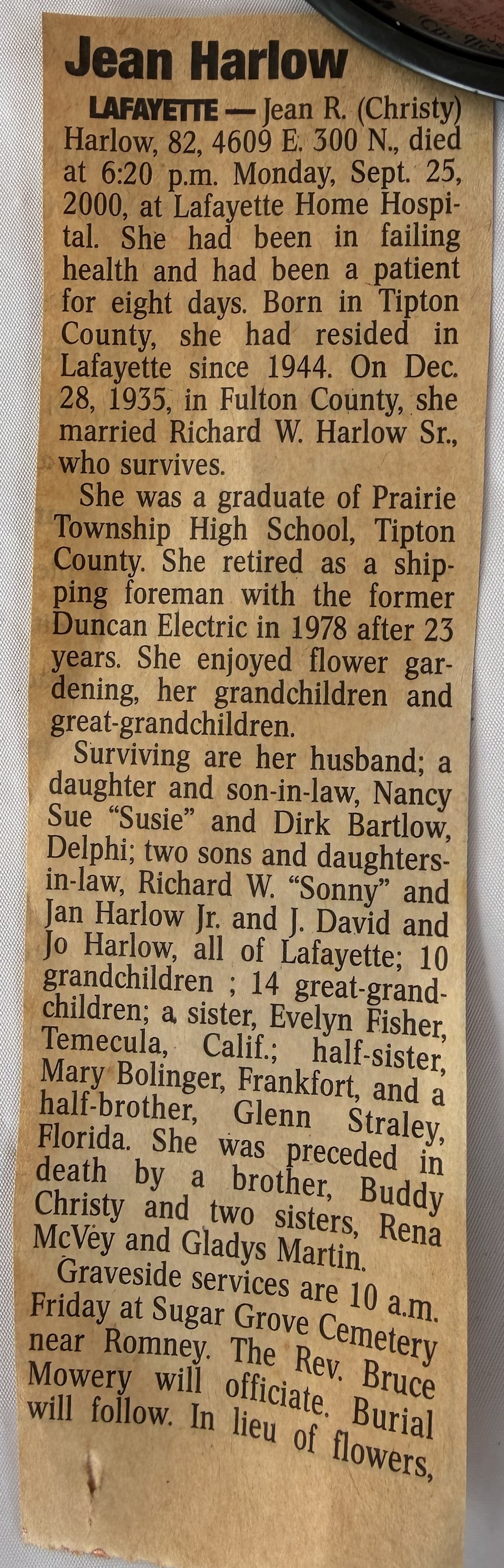
Jean Harlow
LAFAYETTE — Jean R. (Christy) Harlow, 82, 4609 E. 300 N., died at 6:20 p.m. Monday, Sept. 25, 2000, at Lafayette Home Hospital. She had been in failing health and had been a patient for eight days. Born in Tipton County, she had resided in Lafayette since 1944. On Dec. 28, 1935, in Fulton County, she married Richard W. Harlow Sr., who survives.
She was a graduate of Prairie Township High School, Tipton County. She retired as a shipping foreman with the former Duncan Electric in 1978 after 23 years. She enjoyed flower gardening, her grandchildren and great-grandchildren.
Surviving are her husband; a daughter and son-in-law, Nancy Sue "Susie" and Dirk Bartlow, Delphi; two sons and daughters-in-law, Richard W. "Sonny" and Jan Harlow Jr. and J. David and Jo Harlow, all of Lafayette; 10 grandchildren; 14 great-grandchildren; a sister, Evelyn Fisher, Temecula, Calif.; half-sister, Mary Bolinger, Frankfort, and a half-brother, Glenn Straley, Florida. She was preceded in death by a brother, Buddy Christy and two sisters, Rena McVey and Gladys Martin.
Graveside services are 10 a.m. Friday at Sugar Grove Cemetery near Romney. The Rev. Bruce Mowery will officiate. Burial will follow. In lieu of flowers, [clipping ends here]
What it settles, and what it doesn't:
- Ora's household. "Woodrow & Jean" in Ora's letters are almost certainly Richard W. Harlow Sr. and Jean — "Woodrow" is very likely his middle name (Richard W. = Richard Woodrow), though the obituary doesn't say so. Jean is the name in both; Sonny and Jan are their son and daughter-in-law; and Ora's "little greats" (great-grandchildren) fit a household with ten grandchildren by 2000. If Woodrow is Richard W. Sr., then in 1972 Ora was staying with the household of her own son.
- Who Ora was. The 1939 partition deed on the Farm page names "Richard J. Harlow and Ona Harlow, his wife" — the same name as "Ora" in this handwriting (r and n are easily confused in these hands). So Ora L. Harlow is Ona, wife of William's brother Richard J. Harlow of Lafayette, and her "Your Sis" is sister-in-law. Richard W. Harlow Sr. is then, very probably, William's nephew — and Sonny his great-nephew. The obituary alone doesn't prove that parentage; a Tipton or Tippecanoe County record naming Richard W.'s parents would.
- A Prairie Township connection. Jean was born in Tipton County and graduated from Prairie Township High School — the Harlow farm's own township — before moving to Lafayette in 1944; her 1935 marriage was in Fulton County. It fits a wider pattern: the Lafayette Harlows — the "Uncle Richard" whose house Pat lodged at in the 1950s — kept close ties to Prairie Township.
- Buried at Sugar Grove Cemetery near Romney (Tippecanoe County) — not Normanda.
Letters from Pat Cameron (Ryder), niece — 1934–2005
The last and largest collection in the archive, and the one that first opened this whole project: thirty pages kept by Maryanne Patricia "Pat" Ryder Cameron (b. June 19, 1934, Black Rock, N.M.), daughter of Alma Jane Harlow Ryder and niece of William Wilmer Harlow and Lena May Carmony Harlow — genealogy sheets, nursing-school letters, a Zuni memoir, and a Colorado reunion story, transcribed in full below and grouped by page range so the collection doesn't run as one long scroll. Nine pages (5–10, 12–13, 18, 20–21) are withheld from this shared edition.
Pages 1–5
Page 1 (letter_01.jpg)
Handwritten genealogy sheet (ink, cursive) — the Wilcox line: Peter Wilcox's three marriages and children, plus related marriages in the right column.
Top margin (faint, above first line): 1-26-1813 <2-27-1878> [#?] [Noyer?] [illegible]
Peter Wilcox & Eliza Noyer <Jan 24, 1855> — married Jan 24, 1836
- Elizabeth N. Wilcox — Nov 9, 1837 — Nov 4, 183[8?]
- Estella V. Wilcox — May 16, 1840 — <July 6, 1847>
- Talma N. Wilcox — June 30, 1842 — <Mar. 18, 1863>
- Sarah E. " — June 7, 1846 <July 19, 1846>
- Omer T. Wilcox — Sept. 25, 1847 <July 18, 1848>
- Ida Eldora Wilcox — Dec. 8, 1852 <Sept 28, 1936>
Peter Wilcox & Sarah Cosman ("Corman" written above the name) <May 3, 1864> — married Nov. 21, 1855
- (Elmer) Elmore D. Wilcox — Mar 26, 1857 <Nov. 29, 1884>
- Alma Jennie Wilcox — April 1, 1859 <Aug. 22, 1923>
- Wm O. Wilcox — Aug. 21, 1861 <2-15-1862>
Peter Wilcox & Annie Montgomery (born May 1831 <Mar. 1904>) — married Aug 11, 1864
- Jerry L. Wilcox — May 29, 1867 <Mar 24, 1896>
- Mary Wilcox — June 6, 1866 <June 7, 1866>
- George Wilcox — Jan. 27, 1870 <May 31, 1875>
- Uz Wilcox — Dec. 27, 1872 <July 1961>
- Charles S. Wilcox — Aug. 16, 1874 <Oct 21, 1893>
Elizabeth Wilcox — Gilbert Plott, Nov 22 1855
Right column:
- Alma J. Wilcox & Jerome Sparks — July 21, 1878
- Loy Sparks — Nov. 26, 1882 (1933)
- David Harlow & Dora Wilcox — Mar 9, 1880 — "9 children"
- Jerry L. Wilcox & Netta Thompson — Dec. 25, 1890 (his dates repeated: — May 29, 1867 <Mar 24, 1896>; hers: 11-18-1868)
- Uz Wilcox & Bertha [Trunnell?] — June 13, 1898 (annotation above: [died?] 1952)
- Virgil Luther — July 3, 1899
- Larrance Clifford — Aug 6, 1902
Lower right corner: faint diagonal pencil notation [1-26-9?] [illegible]
Notable: Peter Wilcox married three times (Eliza Noyer 1836, Sarah Cosman/Corman 1855, Annie Montgomery 1864). "Dora" Wilcox who married David Harlow Mar 9, 1880 is evidently Ida Eldora Wilcox (b. Dec 8, 1852, d. Sept 28, 1936) — daughter of Peter Wilcox & Eliza Noyer. Uz Wilcox lived to July 1961; his line (Bertha, sons Virgil Luther 1899 and Larrance Clifford 1902) is a living-memory branch.
Page 2 (letter_02.jpg)
Typed genealogy summary sheet of the Harlow family — the five sons of Orlando & Sarah Harlow — with handwritten check-numbers (1–5) over each son and a handwritten margin note. Photocopied over the edge of a typed Christmas letter (fragment at bottom).
HARLOW - ORLANDO & SARAH - 5 BOYS
- JOHN HARLOW (MGT. KEMP)
- SON
- MARY (MCCARTHY)
NANCY
WILLIAM HARLOW (MARY KEMP) [~~GEORGE HARLOW~~ typed beside, struck through]
- DANIEL
JEANETTE
GEORGE HARLOW
- LEE
- LESTER
- CLYDE
- VERNON
CORA
DAVID (DORA WILCOX) — MARRIED 1877
- ADA 1879
- ANNA MAE 1881
- RICHARD 1883
- ASENATH
- INFANT DAUGHTER (9 DAYS OLD)
- BENSON
- WILLIAM WILMER 1891 (MAY CARMONY) — children: WILMER - MIRIAM - JAMES R.
- ALMA JANE 1893 (EUGENE M RYDER) — child: MARYANNE PATRICIA (CAMERON)
EDITH MARIE 1895 (CHARLES EDWARD KELSEY) — children: ROSEMARY (W JOHN KELLER), BRIAN DAVID, JANICE ELAINE; CHARLES EDWARD (BUDDY)
JAMES
- 2 SONS
- ESTHER
Handwritten diagonally in margin (beside William Wilmer/Alma Jane lines): "Marr[ie]d 3-16-46"
Bottom fragment (typed Christmas letter showing beneath the sheet): "...craftsmen around the world use [illegible] their [products?]... This time of year we use the Christmas letter to communicate the years activities in hopes that others will reciprocate with their life stories and the joy of living in the 21st century. Hoping that health is as..."
Correction (Aug 2026): This sheet is the only place in the whole archive where Orlando Harlow's wife is called "Sarah." Four separate Tipton County records spanning 1889–1940 — the 1889 separation deed, the 1901 quiet-title suit, and the 1939–40 quiet-title suit, all transcribed on the Farm page — consistently and repeatedly name her Nancy G. Harlow, and the FamilySearch tree gives her as Nancy Goldsmith Coleman. We read "Sarah" here as a slip in this one typed summary — it isn't the only error on the page (see below) — rather than evidence of an otherwise undocumented wife. The transcription above is left exactly as the document reads; this note is the correction.
Notable: Two brothers married Kemp sisters (John–Margaret "Mgt." Kemp; William–Mary Kemp). David Harlow m. Dora Wilcox "1877" here (page 1 says Mar 9, 1880). Lists David & Dora's nine children including "ASENATH" and "BENSON" (bare names on this sheet, no dates) alongside William Wilmer 1891 (m. May Carmony), Alma Jane 1893 (m. Eugene M Ryder; daughter Maryanne Patricia, married name Cameron — "Pat"), Edith Marie 1895 (m. Charles Edward Kelsey). Margin note "Married 3-16-46" — possibly a marriage date for one of the grandchildren. Note the discrepancy: page 2 makes Alma Jane (b. 1893) the daughter of David & Dora and wife of Eugene Ryder, i.e. "Alma Harlow Ryder" of family lore is William Wilmer's sister, and Pat (Maryanne Patricia) is her daughter.
Added Aug 2026: This sheet's bare "ASENATH" and "BENSON" are Asenath P. Harlow (1886–1909) and Peter Benson Harlow (1890–1911) — Asenath died in Tipton County at 23; Benson died four years later at the Southwestern Presbyterian Sanatorium in Albuquerque, tuberculosis, one of four Harlow siblings (with William, Alma, and Edith above) sent there in 1910–11. See the sanatorium years on the Her Story page.
Page 3 (letter_03.jpg)
Printed DAR application form, filled in by hand (rotated sideways in the photo; transcribed from a rotated copy). Photocopied on top of a July 5, 2004 "Editor Springfield News-Leader" letter (only heading fragments visible: "A very important election is coming up August third – one which is so important it is being...").
APPLICANT'S WORKING SHEET National Society, Daughters of the American Revolution — Washington, D.C.
Written above the printed heading in a different hand: "Mary Harlow McCarthy [Ray?]" and a faint number "1717"
(~~Miss~~ or Mrs.) Patricia Hudak — Wife or Widow of: [blank] Residence: Long Island New York
DESCENDANT OF: Fredrick Kemp
I am the daughter of [first name overwritten/illegible — possibly Hugh D.?] McCarthy, born on May 25, 1887 at ~~Tipton Co Ind~~ [Kempton, Ind?] (overwritten), died at [blank] on [blank], and his (first or ) wife Mary Harlow, born on Dec. 20, 1887 at [Tipton?] Co. Ind (overwritten), died at [blank] on [blank]; married on Nov. 23, 1909.
The said Mary Harlow was the child of John Harlow, born on March 31, 1847 (written over ~~-57~~) at Shelby Co. Ind, died at Kempton on Feb. 26, 1933, and his (first or ) wife Margret Alexander, born on Sept. 13, 1850 at Tipton Co, died at [Tipton?] Co on May 20, 1934; married on March 17, 1870.
(continues on next page)
Notable: Applicant: Patricia Hudak of Long Island, New York — evidently daughter of Mary Harlow McCarthy (John Harlow's daughter, see page 2 "MARY (MCCARTHY)"), tracing descent from Revolutionary-era ancestor Fredrick Kemp. Key facts: Mary Harlow b. Dec 20, 1887, m. Nov 23, 1909, to a McCarthy b. May 25, 1887; John Harlow b. March 31, 1847, Shelby Co., Ind., d. Feb 26, 1933 at Kempton (Ind.); wife Margret Alexander b. Sept 13, 1850, Tipton Co., d. May 20, 1934; married March 17, 1870. Places: Shelby Co., Tipton Co., Kempton — Indiana.
Page 4 (letter_04.jpg)
Continuation of the same DAR Applicant's Working Sheet (items 3–5), handwritten in pencil with corrections.
The said Margret Alexander was the child of Jesse Alexander, born on May 24, 1827 at Ohio, died at Tipton [+?] Co. Ind on Dec. 29, 1895, and his (first or ) wife Maria [Whitman?] Kemp ("Whit[man?]" inserted above), born on July 30, 1830 at Frederick Co. Md, died at Tipton, Ind on May 21, 1910; married on Sept. 27, 1849.
The said Maria Whitman Kemp was the child of Gilbert Kemp, born on Dec. 31, 1784 (written above crossed-out ~~1-1-1787~~) at Fredrick Co., died at Tipton Co., Ind on 10-10-1857, and his (first or ) wife Rebecca [K. Heartman?] (surname crossed out/overwritten), born on July 6, 1790 at Frederick Co., Md ("West" [Va.?] written above), died at ~~F—~~ Tipton, Ind on 2-6-1848; married on [7-6-1790?] (overwritten, uncertain — same as her birth date as written).
The said Gilbert Kemp was the child of Fredrick Kemp, born on 2-11-1747 at Md, Frederick Co, died at [sic] 2-17-1814, on [sic] Frederick Co. Md (date and place fields swapped), and his (first or ) wife Dorothy [Hushtager?], born on 7-3-1765 at Frederick Co., Md, died at [Frederick? Co. Md — struck/overwritten] on 12-1831; married on 3-24-1782 (written over crossed-out ~~9-24-1782~~; another crossed-out date beneath: ~~[Oct 2?, 177?]~~).
Notable: Completes the Kemp descent line: Fredrick Kemp (b. Feb 11, 1747, Frederick Co., Md., d. Feb 17, 1814) & Dorothy [Hushtager?] (b. July 3, 1765, m. Mar 24, 1782) → Gilbert Kemp (b. Dec 31, 1784, d. Oct 10, 1857, Tipton Co., Ind.) & Rebecca [Heartman?] (b. July 6, 1790, Frederick Co., Md., d. Feb 6, 1848, Tipton, Ind.) → Maria Whitman Kemp (b. July 30, 1830, Frederick Co., Md., d. May 21, 1910, Tipton, Ind.) m. Jesse Alexander (b. May 24, 1827, Ohio, d. Dec 29, 1895, Tipton Co.) Sept 27, 1849 → Margret Alexander (m. John Harlow). Shows the family migration Frederick Co., Maryland → Tipton Co., Indiana. Fredrick Kemp (b. 1747) is the claimed Revolutionary ancestor.
[Page 5 contains personal family reflections and is held in the family's private file, outside this site.]
[Pages 6–10 contain personal family reflections and are held in the family's private file, outside this site.]
Pages 11–17
Page 11 (letter_11.jpg)
Typed letter, signed, with handwritten notes at bottom.
September 8, 2005
Patricia Cameron 3133 Fall Creek Rd. Branson, MO. 65616
To Whom It May Concern:
I am submitting the necessary form to claim a thousand dollar ($1,000) bond purchased over 60 years ago. At the time the home burned and my aunt died in the fire I attempted to claim this bond. Although I was able to collect on three or four bonds of lesser value, they informed me that they could not track this one. Once again, I am attempting to collect the funds after reading that many billions lay in unclaimed status. My mother purchased the said bond for her sister, using funds she really didn't have at the time, but in an effort to repay my aunt for the time she cared for her at an earlier time. (My mother had tuberculosis and had to be taken to New Mexico for recovery where she was cared for over a two year period.)
One thousand dollars was a great deal of money in 1944, especially for a single parent working for $195/mo. I only hope that records will disclose the purchase of this bond. I do know it existed for I had often seen it in a trunk with other valuables and other bonds. My aunt kept saying that she might need it at sometime – but that time never came and it was never cashed. I did inherit the land which the house sat on plus and additional twenty acres. Insurance was minimal on a house full of antiques and completely remodeled by my mother.
I was confident that the bond was purchased at the post office in Albuquerque as that is where she purchased most of the bonds. She was a federal employee and worked at the Federal Building in Albuquerque, but I didn't think bonds were sold there. On an outside chance the bond may have been purchased in Tipton County, Indiana. I would assume at a bank.
Your efforts are appreciated.
Yours truly,
(signed) Maryanne Patricia Cameron
Maryanne Patricia Ryder Cameron Mother's name - Alma J. Harlow Ryder Aunt's name - Anna Mae Harlow
Handwritten below:
Albuquerque addresses - 810 W. Roma – doubtful - 911 N. Maple – '44, '45 - 423(?) N. 6th – '45, '46
Notable: Pat's full name = Maryanne Patricia Ryder Cameron; address 3133 Fall Creek Rd., Branson, MO 65616 (2005). Mother = Alma J. Harlow Ryder (had tuberculosis, recovered in New Mexico over a 2-year period cared for by her sister; single parent earning $195/mo in 1944; federal employee at the Federal Building, Albuquerque). Aunt = Anna Mae Harlow — died in a house fire (in Indiana; Pat inherited the land plus twenty additional acres); house full of antiques, remodeled by Alma. Now dated precisely via FindAGrave: Dec. 20, 1963, Tipton County, age 78–79 — see the sanatorium years. $1,000 war bond bought ~1944, possibly at Albuquerque post office or in Tipton County, Indiana. Handwritten Albuquerque addresses: 810 W. Roma (marked "doubtful"), 911 N. Maple ('44–'45), 423(?) N. 6th ('45–'46).
[Pages 12–13 contain personal family reflections and are held in the family's private file, outside this site.]
Page 14 (letter_14.jpg)
Typed page (photographed sideways). Bob Cameron's transcription of Pat's handwritten memoir statement, part 1.
I, Bob Cameron, am typing a hand written statement of Pat's, the date of which I'm uncertain.
"Each summer I spent in Indiana because my Mother, Alma Jane Harlow Ryder was a single parent. When Aunt Edith (Alma's sister and Mother of Rosemary Kelsey Keller) had died Aunt Anna (Alma's sister was the "baby sitter" for those out of school months." The first summer I was late in going until Mother found a lady driving that way. I was nine (9) years old – turning ten (10). In the three-four weeks following school closure, I spent time at the public swimming pool and contracted polio. Thanks be to God I was very slightly affected – suffering only high fever, several days of flu like symptoms and my left leg and foot was very slightly affected.
Late June I left with this lady across Rt. 66 to Indiana. As I recall, Uncle William and Aunt Mae had to drive to Terra Haute [Terre Haute] to pick me up. My Mother took off from work at the summers end to take me back to Albuquerque via bus.
The following summer I took the Santa Fe train by myself from Albuquerque to Chicago. Changed trains to the Monon and on to Frankfort where Uncle William and Aunt Mae again picked me up.
Summers were always fun because I spent many days riding the tractor with Him [William], lunches with Uncle William and evenings playing hide and seek with cousins at Uncle Richard's house.
I did have chores to do – feeding the cow and calf, helping weed the corn which was never ending because Aunt Anna and I did it on hands and knees – crawling row by row to make sure all weeds were dug out. Also I helped Aunt Anna pick raspberries (yellow, red, black and purple) by the quart. Wrapped from head to toe except face and hands, we sat
Notable: Bob Cameron typed Pat's handwritten memoir (date uncertain). Mother's full name: Alma Jane Harlow Ryder (single parent). Alma's sisters: Aunt Edith (mother of Rosemary Kelsey Keller; died before these summers) and Aunt Anna (Anna Mae Harlow — babysat Pat summers in Indiana). Alma's brothers: Uncle William (= William Wilmer Harlow, whose wife is "Aunt Mae" — Lena May Carmony) and Uncle Richard. Pat contracted polio at ~age 9–10 (~1943–44) at Albuquerque public swimming pool, mildly affected (left leg/foot). Travel: Rt. 66 by car; Santa Fe train Albuquerque–Chicago, then Monon line to Frankfort, Indiana; pickups at Terre Haute and Frankfort. Farm life with cows, corn, four colors of raspberries.
Page 15 (letter_15.jpg)
Continuation of Bob Cameron's typing of Pat's handwritten statement.
out early in the morning and picked until mid PM. Somedays netted $0.75 a quart for the berries which people awaited to buy.
Some days I read books to Aunt Anna – Heidi, Black Beauty, Beautiful Joe (my favorite). Other times I listened by the hour to her relating stories of her youth and her life in general – hence, my knowledge of much that is related in this "memoir."
The days flew by (except when picking red raspberries and blackberries. Those days were long and hot and miserable with mosquitos "singing in your ears."
Then I would be back in school in Albuquerque. I was not socially popular with school makes [mates?]. I usually had one good friend. But I was usually liked by the teacher because I was a good student. Sometimes the teacher's pet. But I was not a model child – often coming up with something to distress my Mother. As I look back it was most often a ploy to get my Mother's attention. Not only was she a good parent, but also worked 40 – 50 hours at a government job, the Department of Interior. Also, she was the treasurer of the church and a care giver. She was a peacemaker. Church was an important place as was Bible reading. Some of these things sound as though they were more important than I was and I have resisted them, especially Bible reading. Now as I write [t]his and look back probably Bible reading was one of the activities that [c]arried her."
Notable: Aunt Anna's oral storytelling is the source of much of Pat's family "memoir" knowledge. Berries sold at $0.75/quart. Alma worked 40–50 hrs/week for the Department of the Interior (Albuquerque), was church treasurer, caregiver, peacemaker; devoted to Bible reading. Pat schooled in Albuquerque.
Page 16 (letter_16.jpg)
Typed memoir page by Pat (photographed sideways) — Alma Harlow at Zuni/Black Rock, Pat's birth.
Alma Harlow was employed by the Dept. of the Interior in 1930 and was sent to work on the Zuni, N.M. Indian reservation. She was to be the secretary to the Superintendent of the reservation, as well as bookkeeper for reservation. At that time the government pretty much controlled the activities of the reservation and its inhabitants. It was determined that if the government controlled them they would have better schooling, health care and wouldn't misuse funds issued to them for living in very poor conditions. (That is my interpretation.) The government provided day schools for the children, a small hospital and the services of a physician and two nurses on the reservation. One of the teachers was part Zuni, but most staff were white government employees. Housing was provided, as well as the office, in a small community named Black Rock 4 miles from the reservation. (if the Indians needed service, or hospital care they most often walked the distance to Black Rock)
At some point Alma met a Clark Thread salesman by the name of Eugene Ryder. He was truly a salesman and caught the heart of a rather lonely woman who had suffered years of illness at an early age. He traveled thru on the train every few months. On June 23, 1933 they were married in a chapel along the rode [road] to Gallup. Patricia (now Patricia Cameron) was born in this small hospital on the reservation on June 19, 1934. I believe that I heard that I was the first white child born in that hospital which was relatively new at the time. It was later turned into a small hotel or guest house for people visiting the reservation. By then all medical care was given at a large Public Health facility in Gallup. I do know that Caesarian sections were just beginning to be used and it was "fashionable" to administer them if they could find a good excuse. Since my mother was over 40 and had only one lung (2/3 & 1/3) she was considered a health hazard for normal childbirth. The doctor had only done 2 others so he was an expert now and eager to use the scalpel. At that time the surgery was not set up in advance, so as soon as labor pains began the doctor was called in and the procedure began.
The community of "workers" had a circle of friends which limitedly included some of the Indians. Their social life revolved around pot lucks, card games (bridge was popular) and a few dances. It was a big happening when I was born and many gifts, some Indian, were brought in and people eagerly baby sat so that mother could return to work. Actually, an aunt came to live with us in our 2 bedroom bungalow so I was well cared for. I lived in that little town until I was 4 and my mother was transferred to the large office in Albuquerque. The superintendent actually retired (George Trotter) and the office was to be run in a different way. As well as the "professional" staff there were several men who operated the electrical dam and other maintenance in the office and reservation in general. One was a couple who lived next door and had no children. I spent a great deal of time at their place. One day I tripped on their steps as I went out the back door, fell off the steps and landed in a bucket of fish cleanings head down. I still remember laying on their old sink and getting my hair washed in cold water. Also our house was the last in the row of houses so that it set out next to the arroyo and desert. One night I hadn't picked up my toys out of the yard and had to go out there just as it was getting dark. The coyotes were starting to howl and I was scared spitless. I did scurry to get toys picked up and back in the safety of the house.
We recently went back to Zuni and a few people remembered the school principal whose name was Gonzales, and the man who used to have the trading post G.C. Wallace. But
Notable: Key genealogy page. Alma Harlow hired by Dept. of the Interior 1930, sent to Zuni reservation, NM as secretary to the Superintendent and bookkeeper; lived at Black Rock (4 miles from the pueblo). Married Eugene Ryder — a Clark Thread Co. traveling salesman — June 23, 1933, in a chapel along the road to Gallup. Patricia born June 19, 1934, by Caesarian, at the Black Rock reservation hospital — reportedly the first white child born there; Alma was over 40 with only one functional lung (~2/3 of one, 1/3 of other) from earlier illness (the tuberculosis of page 11). An aunt lived with them in the 2-bedroom bungalow to help. Family moved to Albuquerque when Pat was 4 (~1938) when Alma transferred to the large office. Superintendent George Trotter (retired then). Other names: school principal Gonzales; trading-post owner G.C. Wallace.
Page 17 (letter_17.jpg)
Final page of the Zuni memoir; right edge slightly cropped in photo — bracketed letters restored.
most people who would have lived at that time were not known to me and not known t[o] those I talked with.
My mother loved most of the people, but they were held in disdain because they didn'[t] maintain their bodies, their finances or their religion as whites thought they should. Sh[e] spoke of some of the men stinking (BO) when they came in the office. I think back an[d] wonder what we would smell like if we walked 4 miles in 100 degree heat.
Zuni now is a small pueblo with dirt streets and looking poverty stricken. Where are t[he] proud people that loved their Spirit and their sacred mountain known as Thunderbird o[r] Toioloni (Toyoloni) (not sure of spelling). I did go in the museum which is an attract[ive] newer building, but was approached by a man wanting me to buy a bracelet he had ma[de]. The smell of liquor was heavy and I knew that if he could get money it would go to bu[y] the white man's lightning. At one time there were grave restrictions on selling alcohol [to] the Indians because they do not have the capacity to quit drinking that most whites do. [I] don't think that is enforced now.
That is all I can think of. I do have a book with one or two chapters (written by G. Trotter) on the work he did with the Indians at Zuni and he mentions my mother as his assistant.
Honey – Just saw roundrip [roundtrip] air fare for 270.00 on Frontier. Have to buy by Friday. Th[ey] were advertising 39 one way but that was airfare from Denv. To Albuq.
Notable: Closes the Zuni memoir. Pat owns a book with chapters written by G. (George) Trotter about his work with the Zuni that mentions Alma as his assistant — a potential published source to locate. Mentions the Zuni sacred mountain "Thunderbird or Toioloni (Toyoloni)" (Dowa Yalanne/Corn Mountain). Final personal note ("Honey – …") shows this memoir was sent as/with a letter, apparently to family in the Albuquerque area, referencing Frontier airfare Denver–Albuquerque — suggesting Pat was writing from Missouri/Colorado area with the recipient in New Mexico.
Pages 18–24
[Page 18 contains personal family reflections and is held in the family's private file, outside this site.]
Page 19 (letter_19.jpg)
Final page of a typed letter (photocopy) from Maryanne Patricia Ryder Cameron, evidently answering a genealogy/records inquiry about a U.S. savings bond; blurry photo — line fragments transcribed as visible. Handwritten research notes below in a different (later) hand.
I was confident that the bond was purchased at the post office i[n] purchased most of the bonds. She was a federal employee and Albuquerque, but I didn't think bonds were sold there. O[r? an out-?] purchased in Tipton County, Indiana. I would assume at a bank.
Your efforts are appreciated.
Yours truly,
[signed] Maryanne Patricia Cameron
Maryanne Patricia Ryder Cameron Mother's name - Alma J. Harlow Ryder Aunt's name - Anna Mae Harlow
Handwritten notes below the letter:
Albuquerque addresses 810 W. Roma — doubtful 9[0?] N. Maple — '44, '45 423(?) N. 6[th?] — '45, '46
Notable: Pat formally identifies herself as Maryanne Patricia Ryder Cameron, mother Alma J. Harlow Ryder, aunt Anna Mae Harlow — confirming the Ryder/Harlow line. States Alma was "a federal employee and purchased most of the bonds" (matches her Dept. of Interior / Albuquerque Federal Building service); bond possibly bought at the Albuquerque post office or a Tipton County, Indiana bank. Albuquerque residences for Alma (and Pat) in the 1940s: 810 W. Roma (doubtful), ~90 N. Maple (1944–45), 423(?) N. 6th (1945–46).
[Pages 20–21 contain personal family reflections and are held in the family's private file, outside this site.]
Page 22 (letter_22.jpg)
Album page with two items: (1) a black-and-white studio portrait of a young woman, hand-labeled in the corner "High School Grad" — almost certainly Patricia Ryder; (2) a laminated "In Memoriam" bookmark card containing a newspaper obituary clipping from The Kokomo Tribune (Indiana) for Mrs. Alma Ryder. Clipping is out of focus; enhanced crops used; uncertain words bracketed. Date stamp on clipping illegible.
In Memoriam
THE KOKOMO TRIBUNE — Indiana — [date stamp illegible]
Mrs. Alma Ryder
PRAIRIE — (Tribune Area Special) — Mrs. Alma Ryder, [66?], Tipton R.R. 3, died at 9:30 p.m. Wednesday in Methodist Hospital, Indianapolis. She was struck by an automobile three weeks ago, receiving a fractured leg, and death was attributed to a blood clot.
She was born Dec. 2[2?], 18[93?] in Tipton County, the daughter of David and Ida Dora (Wilcox) Harlow. For a number of years Mrs. Ryder lived at Albuquerque, N. M., and for the last six years she had been employed in the office of Herff-Jones Co., Indianapolis.
Surviving are a daughter, Miss Patricia Ryder of Indianapolis; a sister, Miss Anna Harlow, Tipton R.R. 3; two brothers, Richard of Lafayette R.R. [3?] and William of Tipton R.R. [3?]; an uncle, [Ed?] Wilson of Kennard, Ind., and eight nieces and nephews. Three sisters and a brother preceded her in death.
The body has been returned to her sister's home, where funeral services will be at 2 p.m. Saturday with the Rev. Harry Case officiating. Burial will be in Normanda Cemetery. The Ralph McMullan Funeral Home of Kempton is in charge of arrangements.
The family requests that no flowers be sent, but contributions may be made to the Mental Health Assn.
Card imprint (bottom): Memento Associates, 11-42 44th Rd., Long Island City 1, N.Y.
Notable: Alma (Harlow) Ryder's obituary — died at 9:30 p.m. on a Wednesday at Methodist Hospital, Indianapolis, after being struck by an automobile three weeks earlier (fractured leg; death from a blood clot). Born Dec. 2[2?] in Tipton County to David and Ida Dora (Wilcox) Harlow. Lived in Albuquerque for years; last six years employed in the office of Herff-Jones Co., Indianapolis. Survivors: daughter Miss Patricia Ryder of Indianapolis (so before Pat's marriage to Bob Cameron), sister Miss Anna Harlow of Tipton R.R. 3, brothers Richard (Lafayette) and William (Tipton); "three sisters and a brother preceded her in death." Funeral from her sister's home, Rev. Harry Case; burial Normanda Cemetery; Ralph McMullan Funeral Home, Kempton. (Note: age printed reads like "46" but "66" fits a Dec. 1893 birth; obit would then date c. 1959–60.)
Page 23 (letter_23.jpg)
Photographed sideways: an old sepia snapshot (c. 1930s) of a small blond child in a white dress standing beside an adult in dark clothing, in a garden full of peonies, with a low fence and building behind — very plausibly toddler Pat (b. 1934) with a parent or relative. The same laminated Alma Ryder obituary card shows behind the photo, with a sharper partial view confirming: "...R.R. 3, died at 9:30 p.m. Wednesday in Methodist Hospital, Indianapolis. She was struck by [an automobile]..." and the card maker "Memento Associates, 11-42 44th Rd., Long Island City 1, N.Y."
Notable: No new text beyond confirming the obituary's "9:30 p.m." and "R.R. 3" readings; the snapshot is likely young Pat in a family garden, mid-1930s.
Page 24 (letter_24.jpg)
Handwritten letter on torn-out lined notebook paper, first page, from Pat to her mother (Alma) and aunt (Anna Mae) — same series as the ~1957 nursing-school letters. Continuation not in this batch.
Dear Mommy & Aunt Anna,
I meant for you guys to have this letter today, but so it goes. As I guess you already know. I wish to [heck?] you guys would slow down. It makes me so mad for you to work so.
I wish you would leave the washing until I get home. Not only so I could help but so that I might get in my 2 cents worth.
Have you heard anything from [Rosemarie?]? I guess it won't be long now.
I went down about the silverware when picking up [you?]. It was about 5:10 and they were closed & I haven't been able to get down since.
Got a note from Toni and she ask about you guys. Said she had looked for letters from you mother but never found any. She doesn't know our home address. She has quit M[e]lano Inn and starts at the Log Cabin in 2 weeks. She ask for you to write to her. Everything else going O.K.
Babe & Bob drove in Saturday eve. I played golf Sat. afternoon — boy was I pooped! It was so hot. Then I left Uncle Richards about 8:00 & spent the night with Wanda. Had a very nice time. Sunday we practiced and went to the driving range. By 3:30 I was so tired & sick I went to U[ncle] Richards to study. They had gone to Janice & I was by myself. Well I sure got homesick for you guys then. I studied until 12:00. They got home at 11:00. I was typing on my last term paper. I still have some to do on it — about 5 hrs.
Right now I'm waiting to see if the rain will quit so I can get in my last game of golf. I'm afraid I'm out of luck & it has to be in tomorrow.
(letter continues on a page not in this batch)
Notable: Addressed "Dear Mommy & Aunt Anna" — Pat writing to Alma Ryder and Anna Mae Harlow (so before Alma's death, c. 1957 era). She stayed with "Uncle Richards" (Richard Harlow, of Lafayette per the obituary) and mentions Wanda, Janice, Toni (who worked at the "M[e]lano Inn," moving to the "Log Cabin"), possibly Rosemarie (cf. cousin Rosemary Kelsey), a term paper (student days), and golf. Shows Pat lodging with the Richard Harlow family while in school.
Pages 25–30
Page 25 (letter_25.jpg)
Handwritten pencil letter on lined paper, unsigned date, signed "Pat[ti?]". Written to her mother ("mommy"), evidently from summer school (Ypsilanti era, ~1957). A typed page lies beneath it in the binder; its last visible lines are transcribed below as a fragment.
Typed fragment visible above the handwritten page (bottom of an underlying typed letter):
...fill out this insurance form and send it to you and you can get the policy and send it on. O.K.? I think I'll wind off for now because I need to [illegible] and get all dressed up just to go downstairs and eat. How stupid [illegible] a mess more junk for drawing [illegible] (handwritten annotations on the typed page: "states", "[unties through?]")
Handwritten letter:
Oh this life and the next one. Just one week of summer misery left. But worse still just one week left of Harold's [bliss?] [&?] mine. I'm going to miss him so much. I want to [get?] a picture of him — beard & all. He has been studying so hard. When I saw him Friday eve. he was walking toward the library like an old man. I was coming up from behind and could hardly realize it was him. I hope he gets some rest in this week and we get some time in together. I guess we'll go out Wed. eve. We are both a little [pressed out?] then.
Oh I just finished that second game of golf. Thank heavens that is all over for now. I do enjoy the game. I enjoyed this one very much and made a very decent score. I have discovered some of my faults. My drives are 100% better.
Well guess I'd better get on home now mommy. It's 6:30 & I need to get to work on that stupid paper.
Went to see Iolanthe (Gilbert & Sullivan) the other Friday eve. with that grad from Chicago. He seems very nice — but he certainly doesn't move me — just Harold does that. I think this other guy must be a little on the wealthy side. He belongs to Phi Alpha Tau & that registers money.
Well stop working & see you soon. What did Mrs. Steele say? Anything you want me to bring. It may be late Sat. when I get home.
Lovingly Pat[ti?]
Notable: Pat has a serious boyfriend named Harold (bearded, studying hard, seen at the library — same campus, i.e., Ypsilanti/EMU era ~1957); she attended Gilbert & Sullivan's Iolanthe with a Chicago grad student belonging to Phi Alpha Tau; one week of summer term left; she plans to come home Saturday; mentions a Mrs. Steele; underlying typed letter discusses an insurance form/policy being sent on to "you."
Page 26 (letter_26.jpg)
Duplicate photograph of the same handwritten page as Page 25, taken at an angle. It shows more of the underlying typed page, whose additional visible lines read:
...She never said any[thing] about it in her letters [illegible]... [you?] had better let someone or me know when you go to that hospital... [illegible] and I think that you should stay in the hospital [longer?]... [if?] you really had someone that was able to take care of you it would be different... I'll fill out this insurance form and send it to you and you can get the policy and send it on. O.K.? I think I'll wind off for now because I [need to?] [illegible] and get all dressed up just to go downstairs and eat. How stupid [illegible]
(Handwritten text identical to Page 25 — not re-transcribed.)
Notable: The underlying typed letter (writer unidentified, likely Pat typing to her mother) concerns the recipient's upcoming hospital stay — urging her to let someone know when she goes to the hospital, to stay longer, and noting she has no one at home to care for her — plus the insurance form/policy arrangement. Possibly relates to Alma's health.
Page 27 (letter_27.jpg)
Handwritten letter in blue ink on stationery with a green scroll border (photographed sideways; rotated for reading). Begins "Dear Mommy," — evidently Pat writing to her mother from Indiana during a relative's final illness. Page ends mid-sentence ("I've"); continuation not among these photos.
Dear Mommy,
Just a line to let you know to come to Tipton on the bus Friday evening and come prepared to spend the night. Uncle Clyde said he'd appreciate it muchly.
Now don't start worrying & I'll call you if things get worse. But A. Ada is worse. They have her under oxygen, feeding her intravenously and her kidneys won't work at all now. They have given her medicine to make them work & they still won't. Now they fear uremic poisoning. How I wish they had called in another doctor. That one — they have now said a little bit ago that he had done all he could.
She hardly spoke to me and they have her doped so heavy she sleeps all the time and now she talks in her sleep about things that happened years ago. But she doesn't talk very audibly any time.
Uncle Clyde says that Miriam only stayed down in Tennessee to finish getting her divorce.
Mommy - Friday you better call out and ask Mr. Lynn if that letter has come in yet - if it has have him open it up & read it if he will. I've [page ends]
(Fragments of an underlying handwritten page visible at left margin: "I've written Elizabeth & ask them - more chicken?" and other partial lines.)
Notable: Aunt Ada dying (on oxygen, IV feeding, kidney failure, feared uremic poisoning) at Tipton, Indiana; Uncle Clyde is her husband/host there; recipient ("Mommy," i.e., Alma) asked to come to Tipton by bus Friday evening; cousin Miriam (Wm. & Lena Harlow's daughter) stayed in Tennessee to finish getting her divorce — a significant family fact; a Mr. Lynn holds/receives mail for the family; an Elizabeth mentioned in marginal fragment.
Page 28 (letter_28.jpg)
First photograph of a typed/computer-printed memoir page titled "SUMMER VACATIONS IN COLORADO WITH THE HARLOWS (How to have fun with Scrooges and save money)". This shot crops the right edge; Page 29 is a complete re-shot of the same page — full transcription given there.
Notable: Same content as Page 29 (see below). Handwritten annotation over "Dodge truck": "better known as the Gra[y?] Dragon."
Page 29 (letter_29.jpg)
Complete photograph of the memoir page begun on Page 28. Author is one of the Camerons — almost certainly Pat (Harlow) Cameron, whose family lived in Colorado; "Bob" (Bob Cameron, her husband) drives the Jeepster, and the visiting "Harlow family" cousins come to their creek-side home outside Conifer, CO. The "year of scarce gasoline" places this trip in 1973–74 (oil-embargo gas lines, per Page 30).
SUMMER VACATIONS IN COLORADO WITH THE HARLOWS
(How to have fun with Scrooges and save money)
Every year when the Harlow family came to Colorado we tried to plan at least 2 excursions out into the high country. This year we left our beautiful creek side home outside of Conifer, CO and set out for Breckenridge. Since this was the year of scarce gasoline we were doing a couple of short trips. Part of the visiting cousins would have preferred to just stay at our place, rather than travel the shelf roads to some remote mountain area. Two of the gals, namely Sue and Bethany, did not like driving the mountain roads one bit. They always tried to be good sports and go along with the crowd but they did so with fear and trepidation. The five adventure loving guys took the 4 wheel drive Jeepster so that they could go on some of the far back mountain roads.
The gals set out in the Dodge truck (handwritten insertion: "better known as the Gra[y?] Dragon") with all of the important items such as food, bedding and clothes. At Como, CO we departed to the right to go up over Boreas Pass. In this remote town, the old railroad round house still exists as part of the history of this area. The road we are driving pretty much follows the old narrow gauge train bed that went into Breckenridge, CO. It was the highest in elevation narrow gauge railroad in the US. Built in 1872 as a spur by the Union Pacific; it carried the name, Denver, Colorado Southern and South Park Railroad. It served the Leadville to Denver area for 66 years until it was closed in 1938. To build the spur that went to Breckenridge was an engineering feat because of the heavy snowfall and cold winters. At the top the elevation was 11,400 feet. There stood the remains of an old ghost town which had been named Boreas after the God of wind and cold. A lonely two-story building and a smaller cabin were all that remained. The two story building had once been a bunkhouse or low grade hotel for the construction crew and served some passengers later on. Now, it and the cabin have been restored for cross-country skiers to rent for overnight treks. Also at the crest were the headwaters of what would become the Blue River as it descended the steep grade to the valley below. As we drove on we came upon an old water tower that replenished the steam engine as it climbed the 3% grade from Breckenridge to the top. Most of us were enjoying the trip, but the two mentioned previously were now bending heads close to the floor of the truck. I always loved to drive this pass, so I was particularly excited to tell new people of the history of this road. Soon we were descending past aspen groves and coming into abandoned mines that scattered the hillside. Then into the little town of Breckenridge that was just beginning to ascend the ladder to become one of the prime ski areas of Colorado.
While we made our journey, the guys drove on to Hwy. 9 at Fairplay. They turned onto this highway to begin their journey toward Hoosier Pass. Just short of the pass, they made a left
Notable: The Cameron home was creek-side outside Conifer, CO; annual Harlow-family Colorado reunions with at least 2 high-country excursions; cousins Sue and Bethany named (feared mountain roads); family vehicles: a 4WD Jeepster and a Dodge truck nicknamed the "Gra[y?] Dragon"; route: Como → Boreas Pass (11,400 ft) → Breckenridge; guys' route: Hwy 9 at Fairplay toward Hoosier Pass; "year of scarce gasoline" dates the trip to the 1973–74 fuel crisis, when Breckenridge was "just beginning" as a ski area.
Page 30 (letter_30.jpg)
Second page of the Colorado memoir (photographed sideways; read rotated). Continues directly from Page 29.
turn onto a four wheel drive trail that led to a couple of old mines way back on the mountain which they intended to explore. Even though it was late July they came upon a large snowfield still thawing as though spring had just arrived. Appearing too deep to drive thru, Bob decided to go around. When they hit the mud downhill from the snowbank, the Jeepster, even though in 4-wheel drive began to slide downhill. The guys jumped out to hold the Jeep upright as it tilted precariously to the downside. Then they began pushing backwards while Bob steered. With God's help they got out of there with nothing more than mud splattered clothes and sun burns as they rode with the convertible top down. They made it back to the highway and proceeded on into Breckenridge to meet the gals and tell their tale of high country adventure.
The Camerons had a small motel in downtown Breckenridge and one room of approximately 300 square feet was empty. Eleven of us poured into this one room to spend the evening and attempt sleep. Bob fixed a spaghetti dinner which was readily devoured by the very hungry crew and we sat around recreating the day's adventures.
Sleeping was somewhat of a challenge, but what the heck, we were having fun! The guys were moaning and groaning with painful sunburns. The adults made do with 2 twin beds, the older teenagers fit comfortably along the walls and the younger kids had to tuck in under a makeshift desk. Once sleep descended, we all slept well.
After breakfast the men set out once again to find treasure in old abandoned mines of the area. The girls sought out shopping and walking the narrow streets of the town. But of most importance, we were delegated to wait for almost one hour in line to get gas. A beautiful mountain picnic ended our short vacation in the high country before returning to our beautiful spot in the lower country.
What beautiful memories and good times. Now those youthful kids are grandparents themselves. Some return annually to Colorado to explore more of the backcountry.
Notable: Bob (Cameron) drove the Jeepster on the near-disastrous snowfield/mudslide episode near Hoosier Pass in late July; "The Camerons had a small motel in downtown Breckenridge" — the extended family (11 people) slept in one ~300 sq ft room; hour-long gas lines confirm the 1973–74 fuel-crisis dating; closing line ("those youthful kids are grandparents themselves") shows the memoir was written decades later, likely by Pat Cameron in her later years (Branson, MO era).